
Scenic Design Coursework
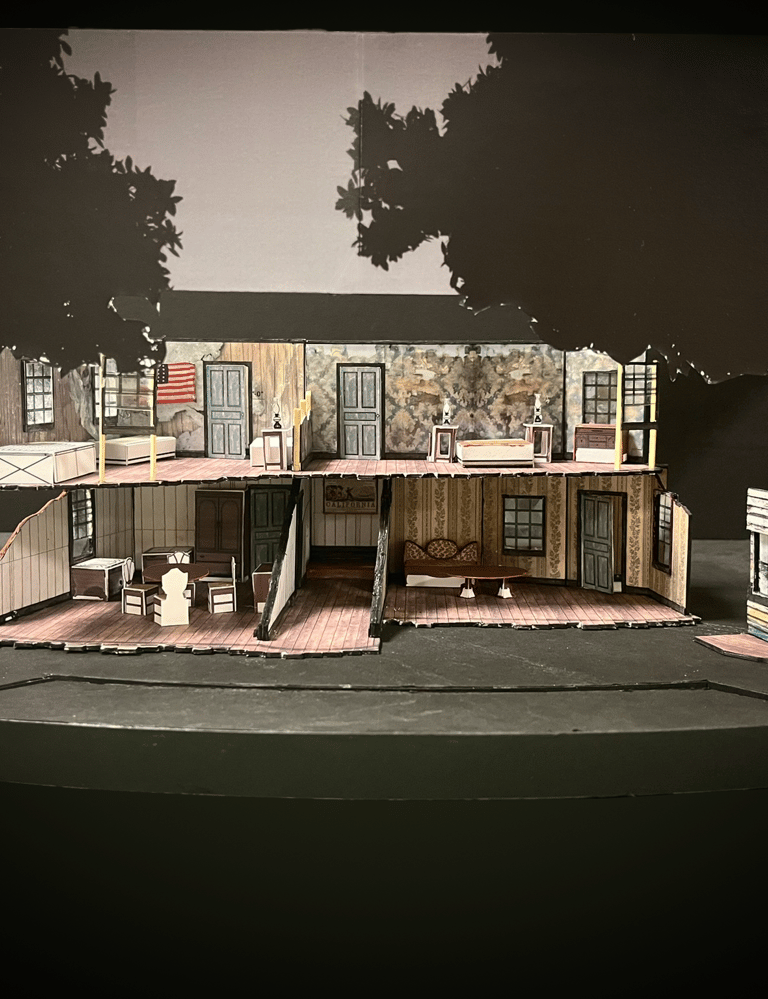
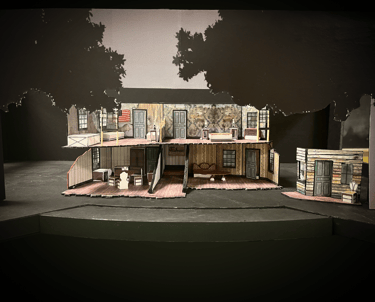
Desire Under the Elms by Eugene O'Neill (2024)
Course: Scenic Design II - Advanced Single-Set Design (Drama)
Instructor: Gennie Neuman Lambert
Venue Style: Proscenium
Concept Summary: For Desire Under the Elms (1924), I pushed the idea of a worn‑down New England farmhouse to its breaking point; the house is visibly collapsing under the same pressure that’s tearing the Cabot family apart. Every warped board, peeling surface, and sloping wall reinforces the tension inside the home. The drafting plates and paint treatments show this clearly, especially the distressed textures and the way the architecture literally sags toward the audience.
My historical research supports this approach: in the mid‑1800s, property was a major marker of stability, even when that stability was an illusion. As noted in my research, “markers of wealth were evident in both exterior and interior applications,” which makes the Cabot farmhouse a perfect symbol of a family clinging to something that’s already falling apart.
By letting the house crumble in real time, the design makes the emotional stakes visible. The home becomes a physical manifestation of resentment, inheritance, and the slow erosion of the family itself.
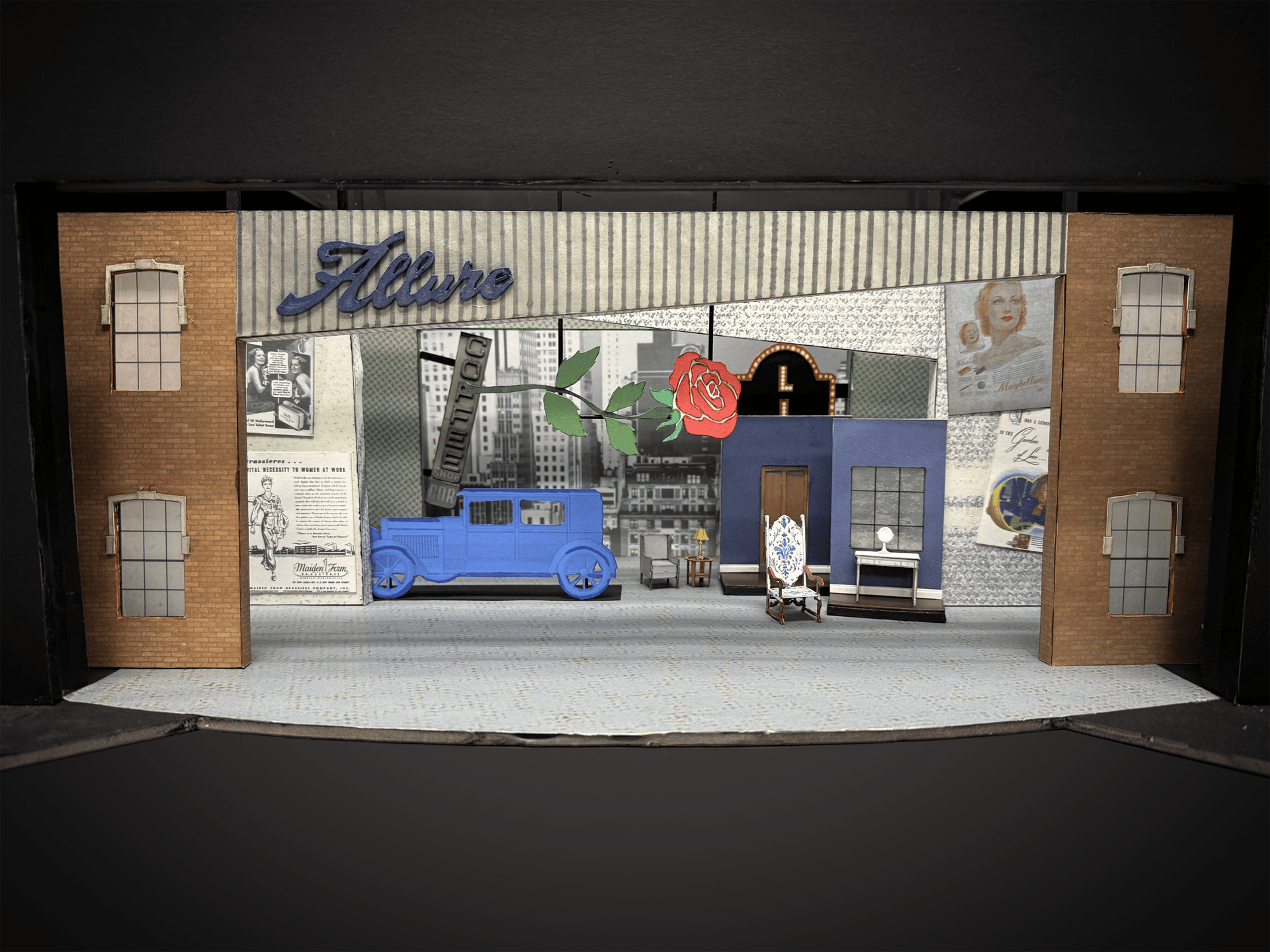
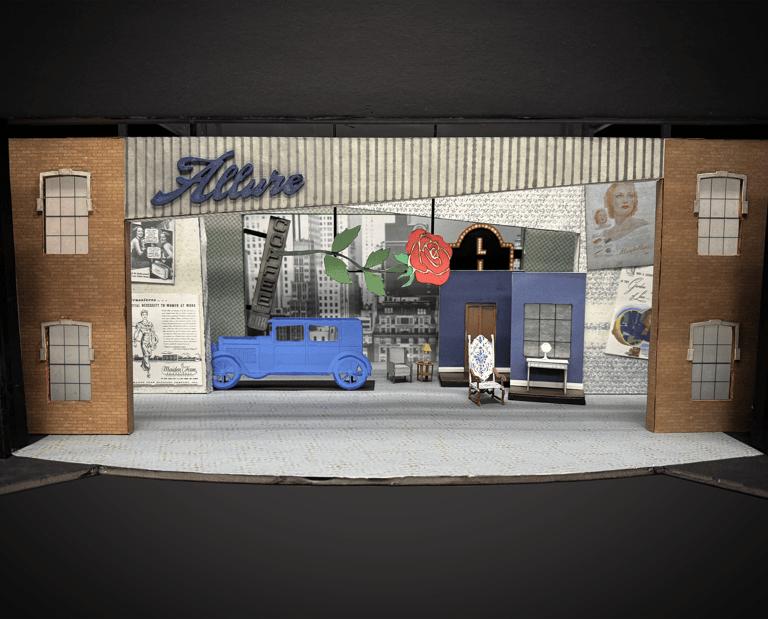
Lady in the Dark by Moss Hart (2024)
Course: Scenic Design III - Designing Beyond Drama (Golden Age Musical)
Instructor: Gennie Neuman Lambert
Venue Style: Proscenium
Concept Summary: My design for Lady in the Dark (1941) focuses on the split between Liza Elliott’s polished public identity and the chaotic, dream‑logic world she’s trying to keep contained. The real‑world spaces, Brooks’ office and Liza’s office, stay grounded and architectural to reflect the rigid expectations placed on her. But the moment she hums the opening bars of “My Ship,” that stability dissolves, and the scenery shifts into heightened, expressive environments that expose what she’s actually wrestling with.
The visual language pulls from 1940s fashion culture and the glossy world of Allure magazine. Bold advertisements, curated glamour, and period typography sit beside surreal distortions, circus iconography, and dreamlike exaggeration. Each dream sequence externalizes something specific (such as vanity, fear, memory, and indecision) and the scenery leans into that symbolism rather than hiding it.
The result is a world where the scenery becomes a diagnostic tool. The real world is rigid and masculine; the dream world is fluid, theatrical, and deeply personal. As Liza moves between them, the audience watches her unravel and rebuild herself: visually, emotionally, and spatially.
This page presents a curated selection of graduate-level scenic design coursework, highlighting conceptual development, drafting and model-building proficiency, research integration, and production process. Each project includes contextual framing, course relevance, and documentation of design methodologies.
Lili Elbe by Moss Hart (2025)
Course: Scenic Design IV - Advanced Multi-Setting Design (Opera)
Instructor: Gennie Neuman Lambert
Venue Style: Proscenium
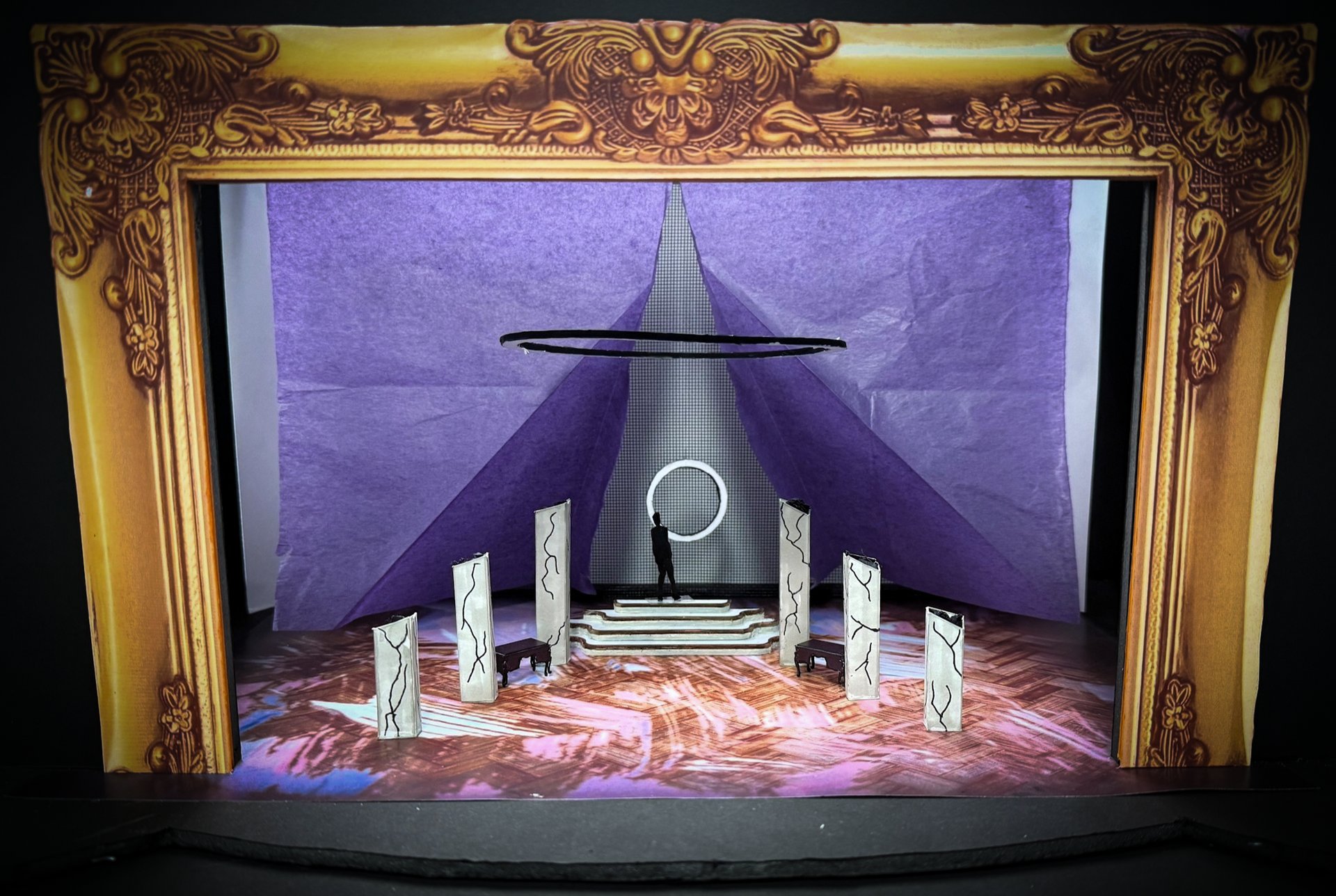
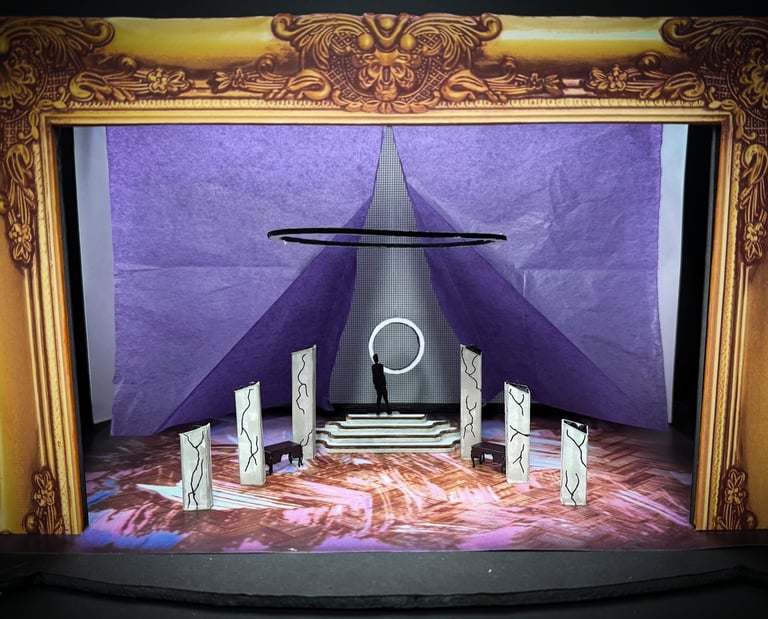
Concept Summary: My design for the opera Lili Elbe (2022) centers on transformation, grounded in the real history of Lili Elbe, a transgender woman and one of the first people to undergo gender‑affirming surgery. The opera moves between literal spaces and subjective, internal ones, and the scenery follows that same arc. Early scenes stay rooted in realism -- concrete places such as the Royal Danish Theatre, Elbe's Copenhagen apartment, her Paris studio --because Lili is still navigating the world through structures that don’t yet see her.
As Lili steps more fully into herself in Act II, the environment becomes increasingly abstract and expressive. Scenic elements show this shift: translucent fabric walls, layered scrims, floating light rings, and vertical elements that let the world dissolve and reform around her. These elements mirror the opera’s blend of realism and myth, especially the recurring Orpheus/Eurydice motif.
By the end, the space becomes lighter, more transparent, and more vulnerable, culminating in the stark simplicity of the hospital room. The design treats the stage as a living organism: one that shifts with Lili, reveals her, and ultimately releases her.
© 2026 M.K. Barber Designs. All rights reserved.